
Chemical industry
Acids, bases, corrosive and toxic products
Vertical
HDPE by extrusion-winding for chemicals. PP by sheet fabrication for heat, food duty and potable water. Not the same material.
Vertical HDPE tanks are a reliable way to store corrosive chemicals safely. Acids, bases and industrial effluents: EELIX sizes a durable PEHD tank to match your site. Food-grade liquids and hotter processes belong on PP, not HDPE.
The vertical HDPE ranges cover indoor and outdoor use, from small vessels to large tanks. HDPE resists corrosion and deformation in chemical duty; PP is a different material for heat and food contact.
Every tank is built to order: dimensions, nozzles, accessories and layout (single skin, jacket or integral bund). Engineering support covers the fluid, density, temperature and regulatory constraints.
| Product | Formula | UN | Hazard | Class | Seals | Density | A2K | Series |
|---|---|---|---|---|---|---|---|---|
| Hydrochloric acid | HCl | 1789 | 80 | Corrosive | EPDM | 1.19 | 1.2 | Chemical |
| Citric acid | C6H8O7 | 1760 | 80 | Corrosive / harmful | EPDM | 1.23 | 1.17 | Chemical |
| Nitric acid 58-60% | HNO3 | 2031 | 80 | Corrosive | FPM | 1.45 | 2.5 | Oxidizing |
| Phosphoric acid 75% | H3PO4 | 1805 | 80 | Corrosive | EPDM | 1.75 | 1.2 | Heavy |
| Sulfuric acid <51% | H2SO4 | 1830 | 80 | Corrosive | FPM | 1.28 | 1.1 | Chemical |
| Sulfuric acid <78% | H2SO4 | 1830 | 80 | Corrosive | FPM | 1.71 | 1.1 | Heavy |
| Sulfuric acid 96-98% | H2SO4 | 1830 | 80 | Corrosive | FPM | 1.84 | 2.7 | Special |
| Ammonia 24.5% | NH4OH 24.5% | 2672 | 80 | Corrosive / irritant | EPDM | 0.966 | 1.1 | Chemical |
| Sodium bisulfite | NaHSO3 | 2693 | 80 | Corrosive / harmful | EPDM | 1.3 | 1.2 | Heavy |
| Sodium chlorite | NaClO2 | 1908 | 80 | Corrosive / harmful | FPM | 1.3 | 1.4 | Heavy |
| Ferric chloride | FeCl3 | 2582 | 80 | Corrosive | EPDM | 1.45 | 1.2 | Heavy |
| Sodium hypochlorite <12.5% | NaOCl | 1791 | 80 | Corrosive / irritant | FPM | 1.23 | 1.9 | Heavy |
| Calcium nitrate | Ca(NO3)2 | 1454 | — | Irritant / oxidizing | EPDM | 1.42 | 1.1 | Heavy |
| Hydrogen peroxide <70% | H2O2 | 2014 | 85 | Corrosive / oxidizing | EPDM | 1.3 | 1.5 | Oxidizing |
| Caustic potash | KOH | 1814 | 80 | Corrosive | EPDM | 1.51 | 1.1 | Heavy |
| Caustic soda 30% | NaOH | 1824 | 80 | Corrosive | EPDM | 1.3 | 1.2 | Chemical |
| Caustic soda 50% | NaOH | 1824 | 80 | Corrosive | EPDM | 1.5 | 1.2 | Heavy |
| Aluminium sulphate | Al2(SO4)3 | 3264 | 80 | Corrosive | EPDM | 1.33 | 1.1 | Chemical |
| Urea | CO(NH2)2 | — | — | Irritant | EPDM | 1.2 | 1.1 | Chemical |
| Wac-HB (basic aluminium polychlorosulphate) | Aln(OH)mCl3n-m | 3264 | 80 | Corrosive | EPDM | 1.15 | 1.1 | Chemical |
Indicative only: material, seals and series are confirmed against concentration, temperature and service life. Engineering validates compatibility for each project.
Installation is designed to be fast: prepared nozzles, fitted accessories, full documentation. Your storage is ready without juggling multiple contractors.
An EELIX vertical tank is easy to maintain. Smooth walls clean quickly, which extends service life and protects the stored fluid — including on mobile or reconfigurable sites.
HDPE mainly serves corrosive chemicals. PP serves heat, food duty and potable water. The fluid decides the material — they are not substitutes for each other.
Acids, bases, corrosive and toxic products
Food-grade liquids, pastes, canned products
Liquid medicines, skin-care products
Fuels, lubricating oils, petroleum derivatives
Water, used lubricants, biomass
Helical extrusion-winding offers a strong quality-to-price ratio for corrosive chemicals, heavy loads and series production. EELIX is the sole holder of the Schoeller-Allibert process: a single-piece, seamless tank to EN 12573-2, up to 100 m³.
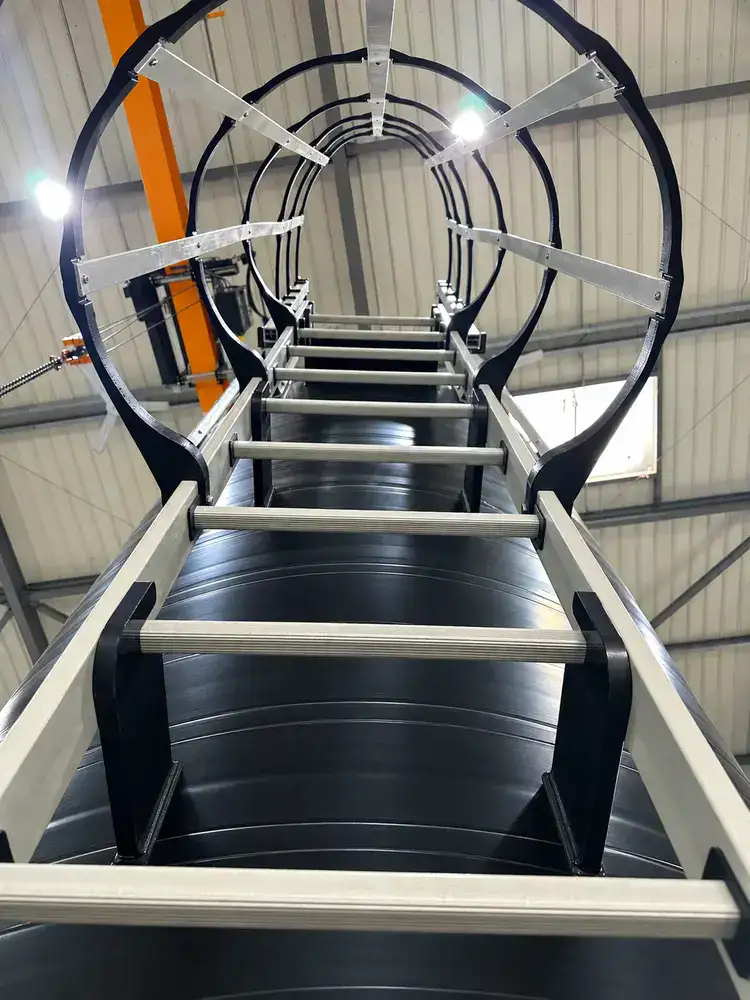
HDPE is extruded continuously and wound in a spiral around a mandrel. The wall is homogeneous, with no weak joints, and can take nozzles, ladders, manways and instrumentation.
An economical cylindrical vessel, easy to install and move. From a few hundred litres to several tens of thousands. Fine for low-hazard fluids; a bund is still required for polluting products.
Two concentric walls form an interstitial space. It protects against leaks, limits heat loss and safeguards people, the environment and assets. Leak detection can be added, along with drains, fills, level devices and safety accessories.
Fusion-welded sheet fabrication is reliable and economical for small and medium volumes, or when the geometry leaves the standard cylinder. Cutting, bending and polyfusion give a smooth, leak-tight, freely configurable tank.
Sheet tanks can be customised in size, shape and accessories: taps, valves, level indicators, manways. They withstand weather without corroding, which suits outdoor and temporary sites.
One HDPE wall. An economical option for moderate-temperature, non-toxic products, or when an external bund is used.
Inner and outer HDPE layers. Extra protection for toxic or corrosive products, better thermal insulation, optional leak detection.
A simple, robust build for chemicals, industrial liquids and food duty. Other volumes are made to drawing.
| Volume (L) | Inner Ø (mm) | Outer Ø at base (mm) | Tank height (mm) |
|---|---|---|---|
| 600 | 930 | 970 | 1,000 |
| 1,000 | 930 | 970 | 1,500 |
| 1,500 | 1,150 | 1,200 | 1,500 |
| 2,000 | 1,250 | 1,300 | 1,700 |
| 2,500 | 1,300 | 1,340 | 2,000 |
| 3,000 | 1,450 | 1,500 | 2,000 |
| 4,000 | 1,450 | 1,500 | 2,500 |
| 5,000 | 1,650 | 1,700 | 2,500 |
| 8,000 | 2,100 | 2,150 | 2,500 |
| 10,000 | 2,100 | 2,150 | 3,000 |
| 15,000 | 2,280 | 2,350 | 4,000 |
Reference sizes for sheet fabrication. Extrusion-winding covers larger volumes, up to 100 m³ in one piece.
Compared with single skin, the double wall adds leak protection and thermal insulation. Capacity, chemical compatibility and bund rules are checked project by project.
| Volume (L) | Tank inner Ø (mm) | Tank H (mm) | Bund inner Ø (mm) | Bund H (mm) | Outer Ø at base (mm) |
|---|---|---|---|---|---|
| 600 | 930 | 1,000 | 1,150 | 600 | 1,200 |
| 1,000 | 930 | 1,500 | 1,150 | 1,000 | 1,200 |
| 1,500 | 1,150 | 1,500 | 1,300 | 1,200 | 1,350 |
| 2,000 | 1,250 | 1,700 | 1,400 | 1,500 | 1,450 |
| 2,500 | 1,300 | 2,000 | 1,600 | 1,300 | 1,650 |
| 3,000 | 1,450 | 2,000 | 1,650 | 1,500 | 1,700 |
| 4,000 | 1,450 | 2,500 | 1,650 | 2,000 | 1,700 |
| 5,000 | 1,650 | 2,500 | 1,850 | 2,000 | 1,900 |
| 8,000 | 2,100 | 2,500 | 2,300 | 2,000 | 2,360 |
| 10,000 | 2,100 | 3,000 | 2,300 | 2,500 | 2,360 |
| 15,000 | 2,280 | 4,000 | 2,400 | 3,500 | 2,470 |
PP / PPH is not HDPE. It suits hotter processes (up to about +90 °C), food duty and potable water. Concentrated acids and bases remain HDPE territory. PP tanks are mainly sheet-fabricated; a large PP volume is studied separately, without reusing HDPE sizes.